

It feels like the world is going to shit at an unprecedented rate. With a seeming inescapability that is becoming more and more overwhelming, while news portals and social media (and news portals on social media) are shoving so much information and attached sentiments down my throat that my brain’s (biological) inability to cope with it all is becoming frustratingly obvious. There’s a diffuse and often well-hidden line between productively learning about the current (political) status quo, about acts and people and movements so filled with stupidity, malice and barbaric cruelty that it feels ignorant to not be acutely aware of them, and plunging into oceans of contextless and deliberately hyperbolic information that do nothing but rob me of any sense of mental clarity and certainty I previously had. This toxic cocktail of late-stage capitalism, human greed, my monkey brain and the abhorrent shit wherever you look has also noticeably altered the way I think about (current) art. Where before I was inclined to meet a film or show on its own terms, to consider only how it affected me and what themes I’d take away from it, I’ve been noticing that I tend to put them into far broader contexts recently. They don’t exist in some sphere looking down at this reality; they are very much a cog in the machine, for better or for worse.
So we have to hold films accountable. Top Gun: Maverick is home to some of the most thrilling and tactile scenes cinema has had to offer this decade. But no amount of craftsmanship and talent behind the camera can outweigh the fact that they are used to celebrate a military that has done so much harm, both before and after the film’s release. The unhinged creativity of Megalopolis is wasted on a film that has Trump-fanboy Jon Voight as part of its cast and thereby normalizes providing such hateful idiots a stage (among many other problems). Netflix can produce as many high-quality films and shows as they like, as long as they indirectly support a business-model that plans to use A.I. to cut costs (i.e. wages) and exploits real-life tragedies in shows like Dahmer (again, among many other problems), all of them will leave a bad aftertaste, even if they themselves are critical of those practices. There is no Superman to save us, no matter how many superhero-films relish the fantasy, and separating the art from the artist really only works if neither the artist nor their associates (financially) profit off of it.
Squid Game is among the most poignant critiques of late-stage capitalism I’ve seen in a long time. It heightens the inherent inequalities within the system to wonderful extremes, while holding a constant mirror to the person watching. And the profit Netflix has made through that show is ten times bigger than all the good Squid Game could even hope achieve by educating people about that subject. I still really like the first season. But if a great work of art ultimately leaves the world a worse place than it found it, how great can it truly be? I realize that I’m holding Squid Game to unfair standards, but that is the point. It’s unfair. It’s annoying. It’s the reality we are living in. With how precarious the current climate (pun intended) is, it seems short-sighted to treat the business and ethics of cinema as disconnected from it.
And yet, it’s exhausting to do so. As touched upon in the first paragraph, there is an overwhelming amount of man-caused catastrophes currently taking place, all of which come with an unfathomable amount of human tragedy. Piling onto that the competing ideas of how to best fight against them, the general feelings of uncertainty when looking towards the future, the destabilizing rabbit holes that are so easy to fall into when researching about these topics and my difficulties to ban these looming concepts into mental cupboards where they can’t play ping pong with my emotions, it’s a lot. It’s easy to lose a tangible sense of reality when one is bombarded with so much of it. Which is what films at times help to counterbalance. Most films aren’t as much an escape from reality as they are a comfortably isolated slice of it, a specific and abstracted layer neatly molded into a three-act-structure and banned into the two dimensions of my TV screen. They help me take a breather. So to rob them of that quality and force them back into the messy reality that most films want to provide a break from is often mentally draining. But nonetheless, it seems ignorant not to.
This is in no way meant to devalue the indescribable bond that film – as art – can create with individuals and groups of people. Films make me laugh, films help me cry, films offer invaluable perspectives on the world and myself. What I want to get at is my difficulty to view films as merely that. Because the impact of films reaches beyond their artistic merit. They can have measurable effects on the world. Be it through the messages they convey, normalities they portray, people they empower, marketing they are backed by, systems they operate in or any other puzzle-piece within or surrounding the film. And there are some films where ignoring that often strikes me as a shortsighted luxury. At the end of the day, it’s up to you where and how you draw the line between the actual film and the contexts surrounding it. There are no guidelines for any of this. But I do believe it’s important to make a conscious decision. I adore Across the Spider-Verse with all my heart. Enough to accept that its success helps normalize animators being forced to work 11 hours a day, 7 days a week to finish a film on time? I have no idea.
With all of this being said, I really want to talk about Snoopy now. Because I’ve been realizing more and more that all of the above has been weighing pretty heavily on me over the last few months. There is an exhausting absurdity in trying to fit a vague angst about the world and my life as a young adult in search of their place in said world under the same roof. Only made worse by how, when you question and scrutinize yourself (and your relationship with art), you usually end up with fewer answers than you started with. So I began reading Peanuts-comics a few months ago to grant myself a break from all this mess. Filled with stories only four panels in length and punchlines that aren’t only funny, but also pleasant. These comics have a stability to them that I’m so desperately missing out there. No matter Snoopy’s hijinks or Charlie’s naivety, the status quo is never threatened. Neither is it when the medium’s conventions get toyed with or the boundaries between Snoopy’s fantasy and Charlie’s reality lose importance. The feelings of pleasantness, togetherness, optimism and boundlessness that are at the comic’s core seem indestructible. The comic became a safe haven from the world out there.
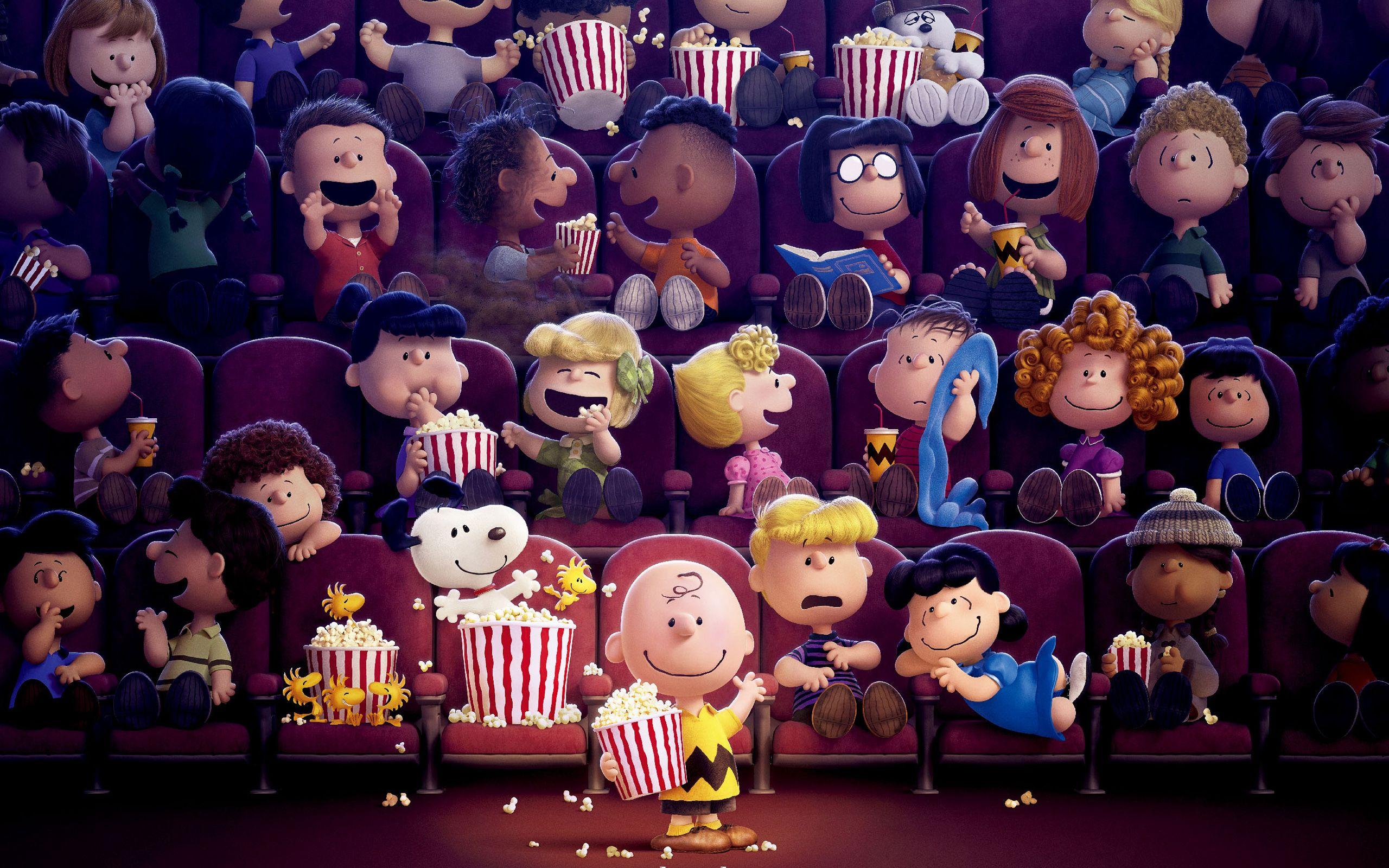
To celebrate the end of the semester, I decided to watch Sony Animation’s take on the Peanuts and its uncompromising positivity. I really liked it. It’s neither some secret masterpiece, nor did I find – or look for – some deeper themes to analyze. But it turned out to be a rather delightful time. The film is very upfront about it being first and foremost a loving celebration of Charles M. Schulz‘s comic. Which, given how meaningful that comic had started to become to me and the reasons why it did, was exactly what I wanted it to be. The designs of the characters and their posing are as close to the original as the medium allows for, the film starts in the hand-drawn style of the comic and ends with Charles’ signature on the screen and the script was partly written by Charles’ son and grandson. It made me smile a lot. Both because of what it celebrates and how it does so. The parts of the film I didn’t fully vibe with don’t matter. Or rather, I have decided for them not to. Because I really only cared for the sense of comfort the film provides.
I still really admire Snoopy as a character, though. Despite him clearly not feeling quite as at home in a feature film as he does in a comic book, he is still amazing. He is living two very different lives at once and not only pulls it off, but excels in both of them. One of which takes place in his fantasy, where he embodies a heroic WWI-pilot on a quest to hunt his arch nemesis and free the girl of his dreams. The story Snoopy comes up with for himself is openly inspired by war stories and films from the first half of the 20th century. A classic tale with dated archetypes. Nonetheless (or maybe even because of that), it’s the coolest thing imaginable for Snoopy, and the film fully supports his excitement. As the dogfights are rendered with wonderful dynamism and color, while the scenes on the ground are drenched in an emotional grandeur reminiscent of films like Casablanca. All the while Snoopy also acts as a best friend to Charlie Brown and supports him in the “real” world the best he can. The film never claims one story to be more important than the other. When Lucy complains that Snoopy’s story doesn’t make a whole lot of sense, he simply throws his typewriter at her.
Seeing Snoopy both be fully present in the “real” world, while also uncompromisingly indulging his fantasy, is a really beautiful image. It’s where I want to get to with my life as a young adult and mentally dealing with the vague fears and uncertainties described above. Where the two can co-exist and influence each other, but without one destabilizing the other. Charlie, on the other hand, is in a different spot. There is a new girl in his class, and, thinking she won’t like him otherwise, he wants to appear as perfect to her as possible. So he tries to trade his real self for a fantasy, an idealized version of himself that can dance flawlessly, make the best book reports and win the talent show. Only to fail time and time again in living up to these impossible standards he sets for himself. Turns out people aren’t perfect, no matter how hard they may try. Yet, by the end, he realizes nobody (decent) expects him to be. It’s not about being flawless, it’s about how you deal with your imperfections and how you treat yourself and others while doing so. I don’t have anything to add to that. I just think it’s a wonderful message.
Both the Peanuts comics and the film are as much a cog in this reality’s machine as the films and shows I’ve talked about above. Meaning, just as with the others, the aspects that, for example, perpetuate heteronormative frameworks, deserve to be called out. But I genuinely believe that those aspects are dwarfed by the messages of friendship, kindness and togetherness Peanuts conveys (I guess it also helps that, as far as I’m aware, neither Charles M. Schulz nor anyone else involved is a TERF). Peanuts is a cog in the machine, but one that – as far as I can judge – is spinning in the right direction. Which makes it a really comforting place for me to retreat to whenever I feel like removing myself from the enormity and chaos of the machine’s entirety. It still feels like the world is going to shit at an unprecedented rate. And art, as well as the industry backing it, is neither impartial to nor exempt from it. But art can also inform and empower to do better. Like Netflix’s Adolescence shining a light on the dangers of incel-culture. Or it can simply make the world a slightly more beautiful place. As do the Peanuts.
Thank you for reading <3