

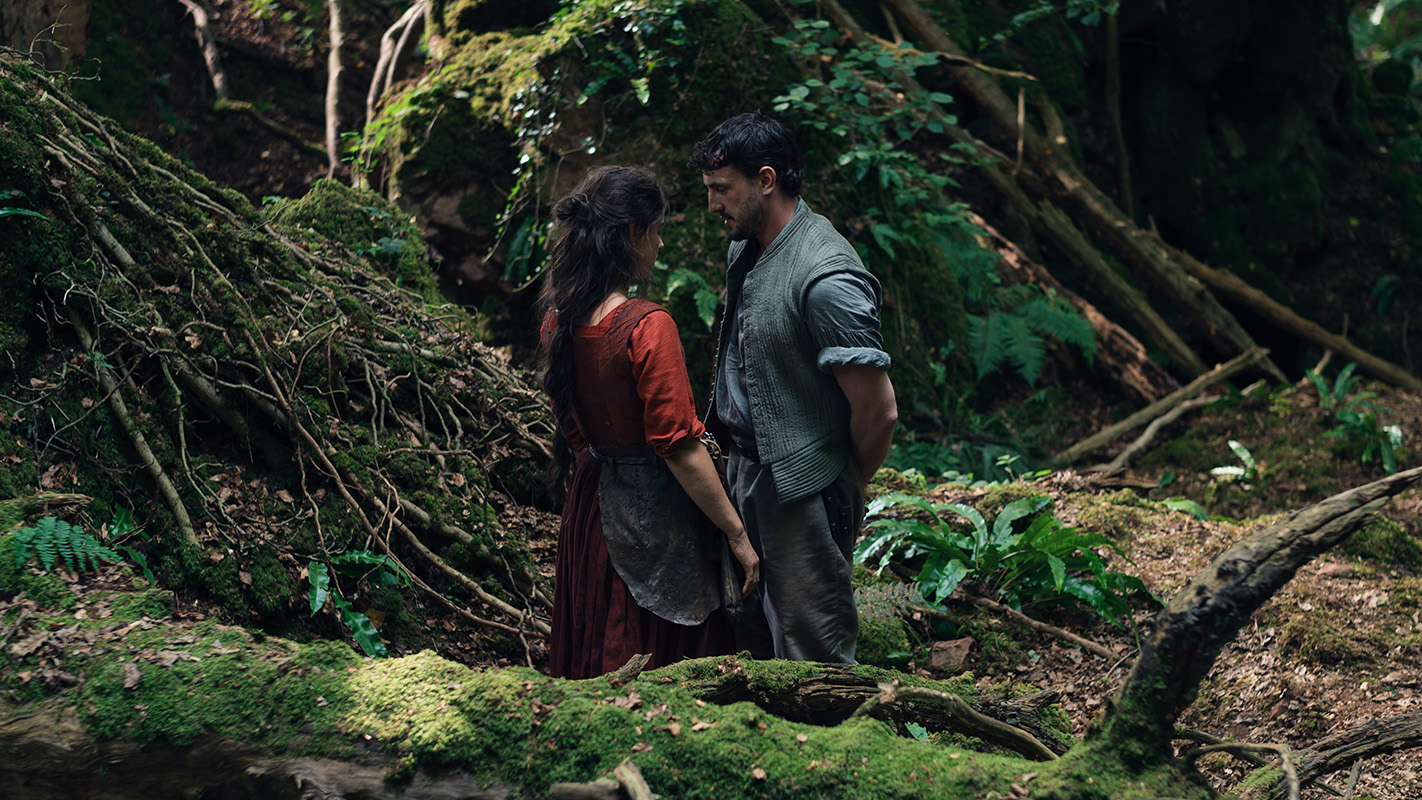
The first time we see William Shakespeare exude eloquence and confidence in Hamnet is when he starts reciting a story to his future wife Agnes. Both of them are in the woods, sheltered from the sexist norms and crippling expectations of their time. Before this, their fleeting interactions were as much dominated by awkwardness as they were by the excitement of their mutual attraction. It’s hardly surprising when William, preceding this first demonstration of his storytelling’s transcendence, gracelessly reveals to Agnes that he often struggles to express himself when directly interacting with others. But it is as soon as he starts talking about Orpheus and Eurydice that the clumsiness fades. He talks about Orpheus’ immortal love for Eurydice and the cruelty of their fates in such lively prose that he must have told the story fifty times already, but beaming with enthusiasm as if he had been waiting to recite the tale ever since he first heard it years ago. It is here that the tragedy-ridden relationship at the film’s center dares to take its first steps.
This wholesome scene already sets the stage for the emotional abysses to come. As always, Paul Mescal’s childlike joy will drown in adult-sized pain just when you started to desperately hope it won’t; expressed with an impregnable brokenness he might as well have trademarked at this point. And Jessie Buckley magical smirk will, before long, be traded in for animal cries of agony and echoing depths of devastation. And yet, despite the horrors waiting on the horizon, the invitingly grounded nature of this scene never fades throughout the film.
Just as Céline Sciamma did with Portrait of a Lady on Fire, Zhao and Maggie O’Farrell (who wrote the original novel and joined forces with Zhao for the film’s screenplay) find much of their film’s soil in the tale of Orpheus and Eurydice. But where Sciamma felt compelled to examine Orpheus’ fatal look back at Eurydice, Hamnet is drawn to the black void Eurydice (almost) arose from. It imagines William and Agnes as two people fighting desperately – and losing mercilessly – against the impenetrable barrier that separates the alive from the dead. Both films end with a yearning gaze inside a theater that carries the emotional impact of an entire film. But their paths there and the pain trapped within these gazes are fundamentally different. Zhao doesn’t tease us with the fantasy of a gay utopia only to then violently rip it away from us; she plunges into the ungraspable despairs that makes people yearn for fiction and utopias in the first place.
The dark, ever-looming presence of death had already taken its first toll long before Agnes met William. Agnes was but a child when she saw her mother’s corpse lying in front of her – she didn’t survive the birth of Agnes’ younger siblings. Agnes was then brought up by a woman that she vehemently refuses to call “mother.” It is the nearby woods, with all its balmy flora, where she feels most at home. In Hamnet’s opening shot we find adult Agnes curled up on the leaf-covered forest floor, cradled by the roots of the nearby trees while immediately standing out from her brownish surroundings with her red dress. She’s lying in the womb of mother earth. Labelled by some of her village as a witch, Agnes doesn’t only display a profound connection to and understanding of the nature around her, but of William as well. She claims to see the entirety of his person through a single touch of their hands – one of the film’s many understated set-ups, be it a gesture, a quote or even a pan of the camera, that will later return with a devastating pay-off.
Zhao isn’t aiming for delicate themes here, she’s aiming for big emotions. The shadowy presence of fatal calamity is constant and foreboding; Agnes and William are neither equipped to deal with its cruel consequences, nor the agonizing emptiness it leaves as its aftermath. In the woods, in their home, or backstage during the film’s final act: Wherever Agnes and William are, Łukasz Żal’s camera reminds us of the afterlife’s presence, it’s luring in the dark corners of the house and the magnetic shadows beneath the trees. An entirely different world, running next to but counter our own. Devoid of any hopes to retrieve what has been lost, no matter how often the film returns to the motif of Agnes emerging from the shadows. A few times we even see the characters from the perspective of death itself, hanging motionlessly in a corner like a surveillance camera – a fact Zhao lets us in on during one of the film’s transcendentally emotional scenes.
Zhao builds towards these highlight scenes, where she channels all the emotional density she has conjured up until that point to craft cinematic spectacle out of tragedy. Once Agnes brings her first child into the world and, soon after, gets pregnant with twins, those scenes of raw, ungraspable emotion turn bone-chilling. Hamnet doesn’t care much about the delicateness of restraint; it treats you to crying children being dragged out of dimly lit rooms, drawn-out scenes of characters in physical or emotional pain while Max Richter’s fills the dead air with a few haunting, solemn notes.
Where Żal’s camera stood out for its unnerving restraint in Jonathan Glazer’s The Zone of Interest, radically denying the nazi-German family any empathy that cameras usually grant their subjects, he now seems eager to compensate. Żal wants to eternalize even the smallest details in Jessie Buckley’s pain-contorted face as Agnes tries to keep her family and sanity intact – William makes mostly note of himself in the film’s second half by being away in London for long stretches of time. Be it while giving birth or while desperately caring for her sick child, we are so close to her agony that I felt her hectic breaths make their way through the cinema.
The texture Zhao imbues the film with keeps these scenes of emotional overdose from ringing hollow. The costumes, props and lived-in feel of Hamnet’s locations are an inviting host for grimy and/or melancholic feelings; Zhao’s talents for prying existential emotions out of nature and makeshift homes is again on full display. As the boundaries between Max Richter’s score and Johnnie Burn’s sound-design slowly melt away, the soundscapes that arise turn transcendent. Hamnet paints in broad emotional strokes – symbols like Agnes’ hawk and the onslaught of apples when Agnes and William first have sex are anything but subtle – but it paints with excitingly rich colors.
Similar praises can be sung for Jacobi Jupe, who plays Hamnet – one of Agnes’ twins – in one of the best child-performances of recent memory. Occasionally reminiscent of Abigail Breslin’s performance in Little Miss Sunshine, he plays his emotions big and simple, with an unwavering honesty that makes them stick. His older brother Noah also gets to prove his Shakespearian intensity in the film’s final act, but it is the face of Jacobi, with a dramatic tear rolling down his round cheek, that haunts the film even after it has finished. Zhao places much of the film’s emotional weight onto his young shoulders, but his performance never falters.
Buckley and Mescal operate on a different register than Jacobi Jupe does. They play the various stages of Agnes’ and William’s relationship – the initial awkwardness, the growing intimacy, the mutual love and the eventual, unbridgeable void between the two – with complete devotion and impressive detail. Yet the modern styles of their performances lend Hamnet an anachronistic quality. Throughout the entire film, but especially once Agnes secludes herself further and William tries to find refuge in the writing and rehearsals of Hamlet (the name “Shakespeare” is only uttered after William has finished the play), we get long shots where Buckley and Mescal can wow us with the amount of acting choices they can fit into a single scenario.
The result is powerful, a radical intimacy arrived at one externalized impulse and thought process at a time, and Zhao consciously plays into its modernity. She ends Hamnet with Max Richter’s “On the Nature of Daylight,” a composition as ethereal as it is firmly situated in the 21st century, using it to help guide the emotions of the film finds into the current day.
Hamnet doesn’t have the lyrical elegance with which Shakespeare investigates the depths of existential suffering, but it has the texture to make the depths felt nonetheless. Walking a fine line between morbid fable and hyperreal emotions, happy to confront the inconceivableness of death head on, it is a tearjerker tailor-made to drag some deeply buried feelings to the forefront and leave them – at least for a while – in the cinema.